
This is part 2 in a 4-part series of findings from the 2025 Youth Washington Muslim Survey.
Bullying by other students
When asked, “During the current school year and the prior school year, how often have you been bullied at school by another student because you are Muslim?” 25% indicated that they were bullied a few times a year or more frequently, 18% that they had been bullied less than once a year, and 57% replied “never”.
In total, 43% of Muslim students have been bullied in the past two school years.
According to StopBullying.gov, “About 19.2% of students ages 12-18 enrolled in grades 6-12 experienced bullying nationwide during the 2021-2022 school year,” meaning that Muslim students in Washington are more than twice as likely to be bullied as the general student population in the U.S.
When asked for more details about the bullying, students replied that they were called things like “bomber” or “terrorist,” were harassed and assaulted for wearing hijab, that other students referenced 9/11 in offensive jokes, and that students or teachers singled out and excluded them for being Muslim.
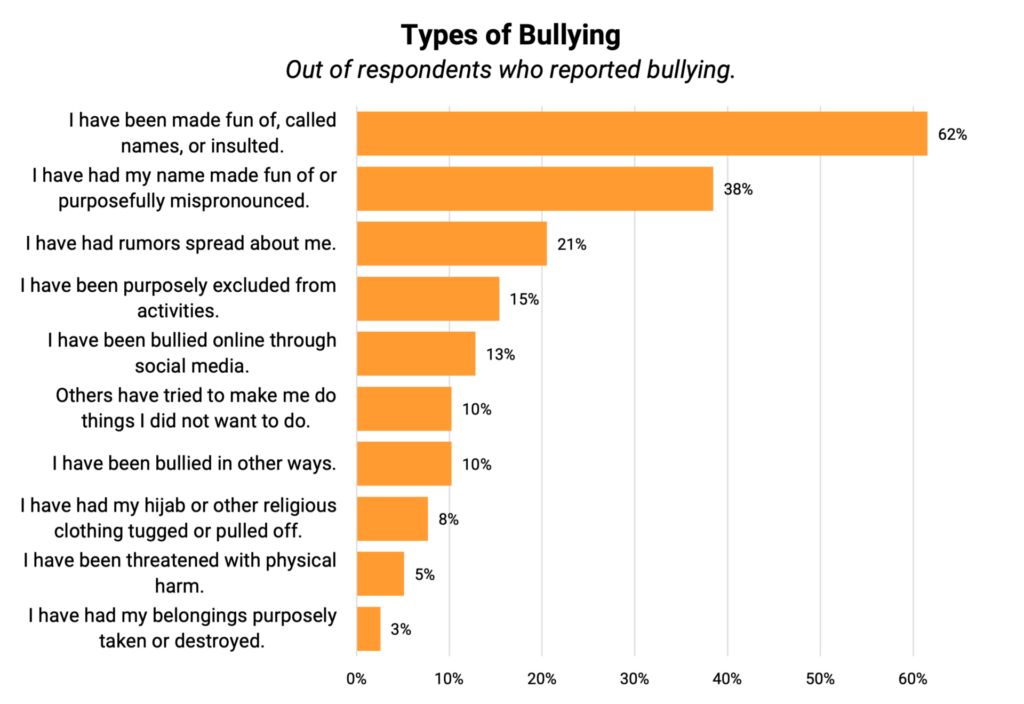
We asked respondents who indicated that they had experienced some bullying by other students if they or a family member reported the bullying to an adult at their school. Out of these respondents, 33% did not report the bullying, 31% did, and 33% indicated that they had not been bullied, despite indicating some experience of bullying on a previous question.
Out of the students who did report the bullying, one-third (33%) said that the school’s response fully resolved the issue, another third (33%) said that the school’s response partially resolved the issue, and the final third (33%) indicated that the school did not respond or that their response didn’t make a difference or made the bullying worse. Note: 12 students responded to this question; each third was 4 students, adding up to 100%.
Of the students who did not report the bullying (15 total), 60% said that they “don’t think it’s a big deal,” 33% said that they “don’t think it will make a difference,” and one or two students each said that they don’t feel comfortable, don’t want to be a “snitch,” are afraid that the report will lead to retaliation, and don’t know who to report it to.
Seeing other students being bullied
When asked, “During the current school year and the prior school year, how often have you seen another Muslim student at school being bullied by another student?” 26% indicated that they have seen another student bullied a few times a year or more frequently, 16% that they had seen another student bullied less than once a year, and 58% replied “never”.
When asked to provide more detail, respondents said that they saw other Muslim students being called things like “terrorist” and “bomber”, having their appearance made fun of for wearing hijab or a beard, or hearing students mocking the Arabic language. Other respondents mentioned physical violence. Many young people mentioned micro-aggressions that were framed as “jokes” or making fun of Muslims and Islam.
Offensive comments on social media
When asked, “How often do students at your school make offensive comments or posts about Islam or Muslims on social media such as Tiktok, Instagram, YouTube or Snapchat?” 28% indicated that they have seen offensive comments or posts on social media a few times a year or more frequently, 21% that they had seen offensive comments or posts on social media less than once a year, and 51% replied “never”.
In total, 49% of Muslim students have seen offensive comments or posts on social media in the past 2 school years.
When asked to provide more details, respondents said that they see jokes about 9/11, people making fun of Islam/Allah/the prophets, hate towards Palestinians, and disregard for Muslim lives.
Hijab harassment
We asked, “If you wear hijab, how often have you had your hijab tugged, pulled, or in any way offensively touched by another student during the current school year and the prior school year?” After removing respondents who don’t wear hijab, 28% of students who do wear hijab had experienced hijab harassment in the past 2 school years.
Discrimination from adults in school
When asked, “During the current school year and the prior school year, how often has a teacher, administrator, or other adult at your school made offensive comments about Islam or Muslims or acted in a way that is offensive to Islam or Muslims?” 11% responded that they experienced this a few times a year or more, and 26% said that they experienced this less than once a year.
In total, 37% of Muslim students have seen adults in their school make comments or act in a way that is offensive to Islam or Muslims in the past 2 school years.
When asked to provide more details, one respondent described a teacher physically assaulting a student, saying, “A teacher once punched a student because he was ‘making too much noise’ when he was opening the door to the prayer room”. Others mentioned being taught incorrect and/or biased information about Islam and Muslims, including that Islam is “oppressive” or “violent”. Multiple respondents mentioned teachers looking at Muslim students during lessons/lectures anytime they say words like “Taliban” or “Hamas”.
When asked, “Have you ever been discouraged by a teacher or advisor from continuing your education?” 8% replied yes.
When asked, “Do you feel your free speech and expression rights have been limited or denied at school?” 35% replied yes.
When asked, “Do you agree or disagree with the following statement: ‘When I have asked for an accommodation because of my religious needs, my teachers and administrators have been responsive (e.g. they gave me time for prayer, an excused absence for Eid, alternative food options, allowed me to wear a different P.E uniform, etc.),’” 75% agreed or strongly agreed, 8% were neutral, and 8% disagreed.
When asked, “How often have you experienced discriminatory policies and practices at school? For example: not being given time to pray, being required to dress in a way that doesn’t align with your religious practices,” 6% replied that they experienced these policies a few times a month or more frequently, 13% said a few times a year, 14% said less than once a year, and 66% said never.
In total, one third (33%) of Muslim students have experienced discriminatory policies or practices at school in the past 2 years.
When asked, “Based on your experiences, do your teachers understand the experiences and needs of Muslim students? For example: understanding the basics of Islam, such as daily prayers, holidays, and fasting during Ramadan,” 54% agreed or strongly agreed, 16% disagreed or strongly disagreed, and the remaining 30% were neutral or marked not applicable.
Thirty-five percent (35%) of Muslim students feel that they have experienced heightened discrimination or bullying at school since October 7, 2023.
Safety at School
When asked, “How often do you feel unsafe or unwelcome at school because of your personal characteristics, including race/ethnicity, religion, or immigration status?” 13% said a few times a month or more frequently, 10% said a few times a year, 25% less than once a year, and 52% said never.
42% of Muslim students have felt unsafe or unwelcome at school because of who they are in the past 2 school years.
When asked, “In the last year, how often have you stayed home from school because you felt unsafe or unwelcome at school?” 10% said a few times a year or more frequently, 4% said less than once a year, and 83% said never.
When asked “Do you agree or disagree with the following statement: ‘Being bullied because I am Muslim has negatively impacted my physical, mental, or emotional well-being,’” 15% agreed or strongly agreed, 19% were neutral, 28% disagreed or strongly disagreed, and 39% said the question was not applicable.
Of those who agreed that being bullied has negatively impacted their wellbeing, they were most likely to identify “feelings of stress or anxiety” as the way that it has impacted them. However, respondents also indicated that they were impacted by feelings of sadness or depression, feelings of loneliness and isolation, changes in sleeping patterns, changes in eating patterns, negative feelings about their selves, performance at school, relationships with my family and friends, losing interest in previously enjoyable activities, and being impacted in other ways.
Protective Factors
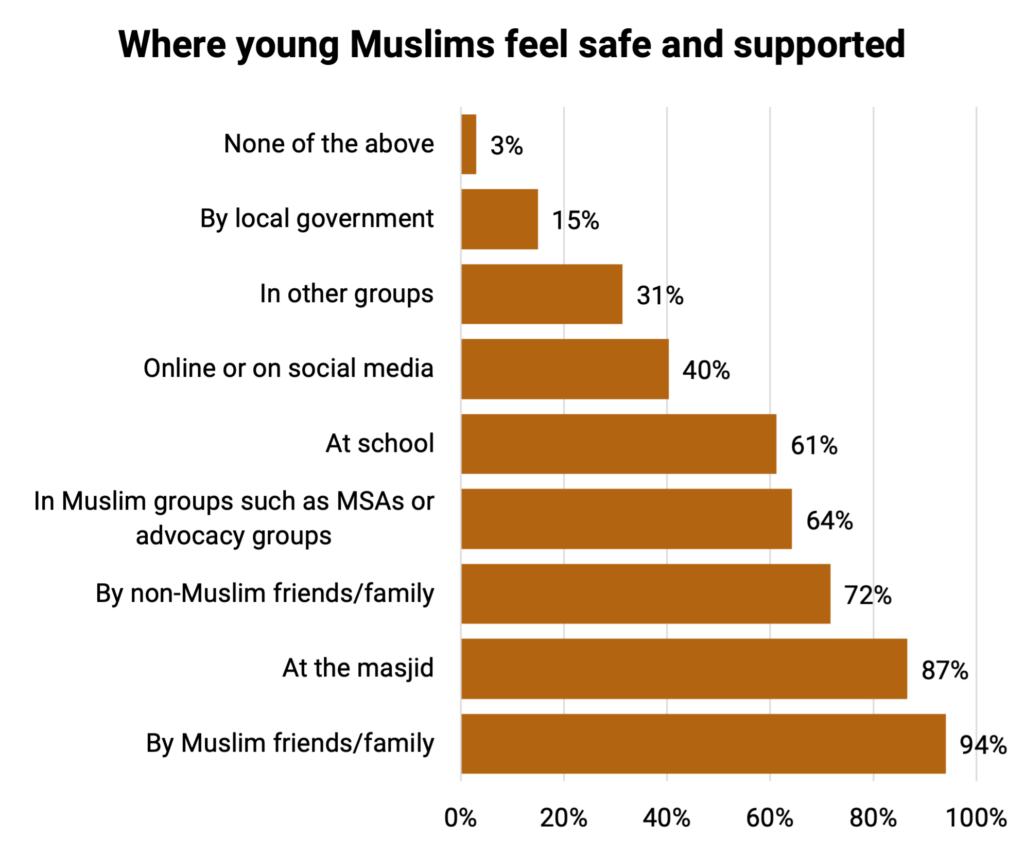
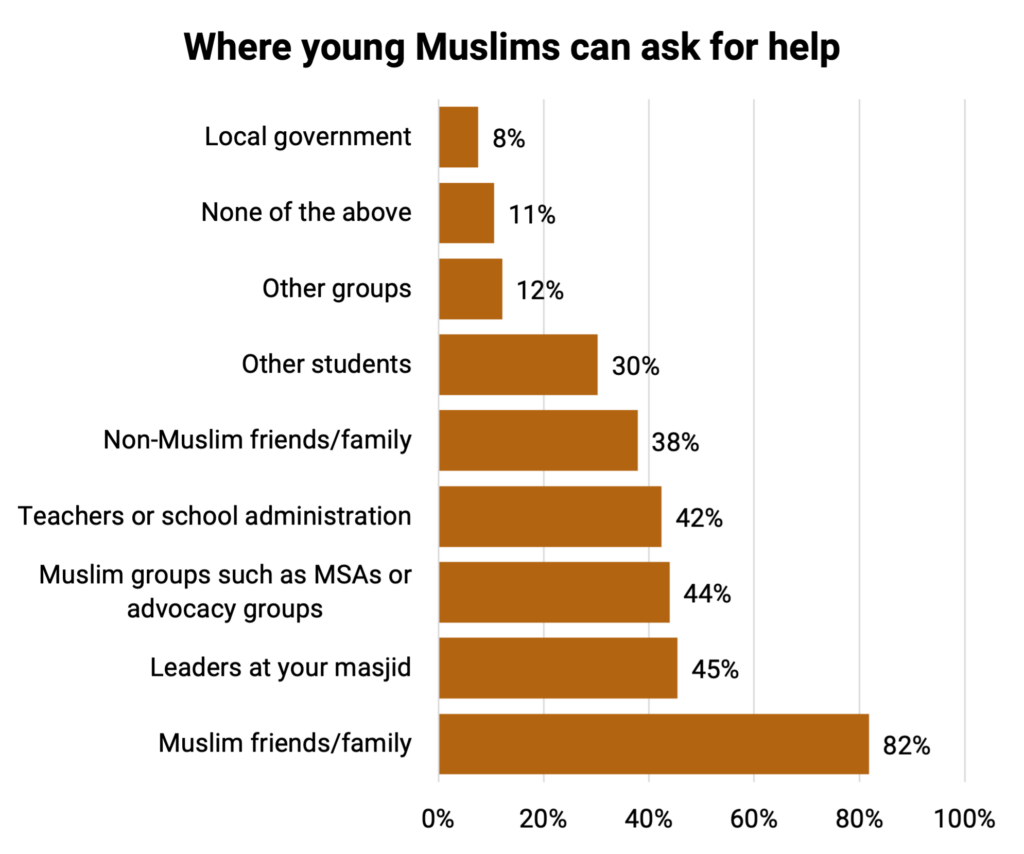
We asked young people where they feel safe and supported, and where they feel that they could ask for help or support if they experience hate, discrimination and bias. Respondents could mark as many boxes as they wanted on these questions, so percentages add up to over 100%.
Ninety-four percent (94%) of respondents feel safe and supported, including in their Muslim identity, by Muslim friends/family, 87% at the masjid (mosque), 72% by non-Muslim friends/family, 64% in Muslim groups such as Muslim Student Associations, and 61% at school. Only 40% of respondents feel safe and supported online or on social media, 31% in other groups, 15% in local government, and 3% responded “none of the above”.
In terms of who they could ask for help or support after experiencing bias, discrimination, or hate, the order was similar though the percentages were lower for every category. Eighty-two percent (82%) of respondents could ask for help from Muslim friends/family, 45% from leaders at the masjid, 44% from Muslim groups such as MSAs, 42% from teachers or school administration, and 38% from non-Muslim friends/family. Only 30% felt that they could ask for help from other students, 12% from other groups, 8% from local government, and 11% said “none of the above”.
Of respondents, 29% attend a mosque or Islamic community center nearly every day, 39% at least once a week, 23% a few times a month, and the remaining 10% a few times a year or less.