
2025 Youth Washington Muslim Survey Report
Introduction
The need for students to have safe and affirming school environments is essential to their emotional wellbeing, academic success, and overall development. Muslim students across Washington State have not always experienced school to be a place of belonging or safety. Youth and families have consistently shown concerns about the persistence of harmful stereotypes, in addition to ignorance around Islam and Islamic practices. These challenges are presented not only by peers, but from school administrations, teachers, and parents, turning school environments into unsafe spaces where Muslim students can feel marginalized and unwelcome.
With a documented rise of increasing Islamophobia nationally and within the state, Muslim students are heavily affected by harassment and bias in their places of learning. Dealing with Islamophobia in educational spaces can affect students’ mental health, confidence, and overall ability to learn. When this hate and prejudice goes unnoticed, it lets students know that their identities are not valuable enough to be protected, like their peers.
Bullying is one of the most damaging and visible ways that this harm tends to manifest. Bullying can lead to decreased academic performance, in addition to depression, anxiety, and long-term emotional distress. When students are targeted for their religious beliefs in educational spaces, the damages are often amplified by feelings of isolation, and a lack of response from institutions.
Despite how severe these issues are, there has been a significant lack of data documenting the experiences of Muslim youth in Washington. Many people choose not to report incidents of harassment, bullying, or discrimination, due to a lack of trust in reporting systems, fear of retaliation, or exhaustion from having to repeatedly explain their experiences. Gaps in data are caused by underreporting, which limits what actions can be taken to increase advocacy and accountability.
This survey was developed to help address this gap. It builds on the efforts of CAIR-CA, who conduct a periodic bullying survey, as well as continuous efforts to support Muslim students and educators, including sending letters to schools and educators twice a year, advocacy with the Office of Superintendent of Public Instruction (OSPI), direct engagement with schools, and strengthening the network of Muslim Student Associations, to promote peer support. This report aims to provide a clearer image of the challenges Muslim students face, so that informed and effective policies can be put in place, and interventions can happen in the future.
Executive Summary
Between May 1 and October 15, 2025, the Council on American-Islamic Relations, Washington state chapter (CAIR-WA), surveyed 147 Muslims who were between 11 and 18 years of age and living in Washington state.
Young Muslims in Washington are generally from families with an immigration story within the past few generations, though in our study the majority of respondents were born in the United States. There is incredible racial and ethnic diversity among young Muslims in Washington, with no racial or ethnic category exceeding 24% of the total, and nearly all respondents speaking multiple languages.
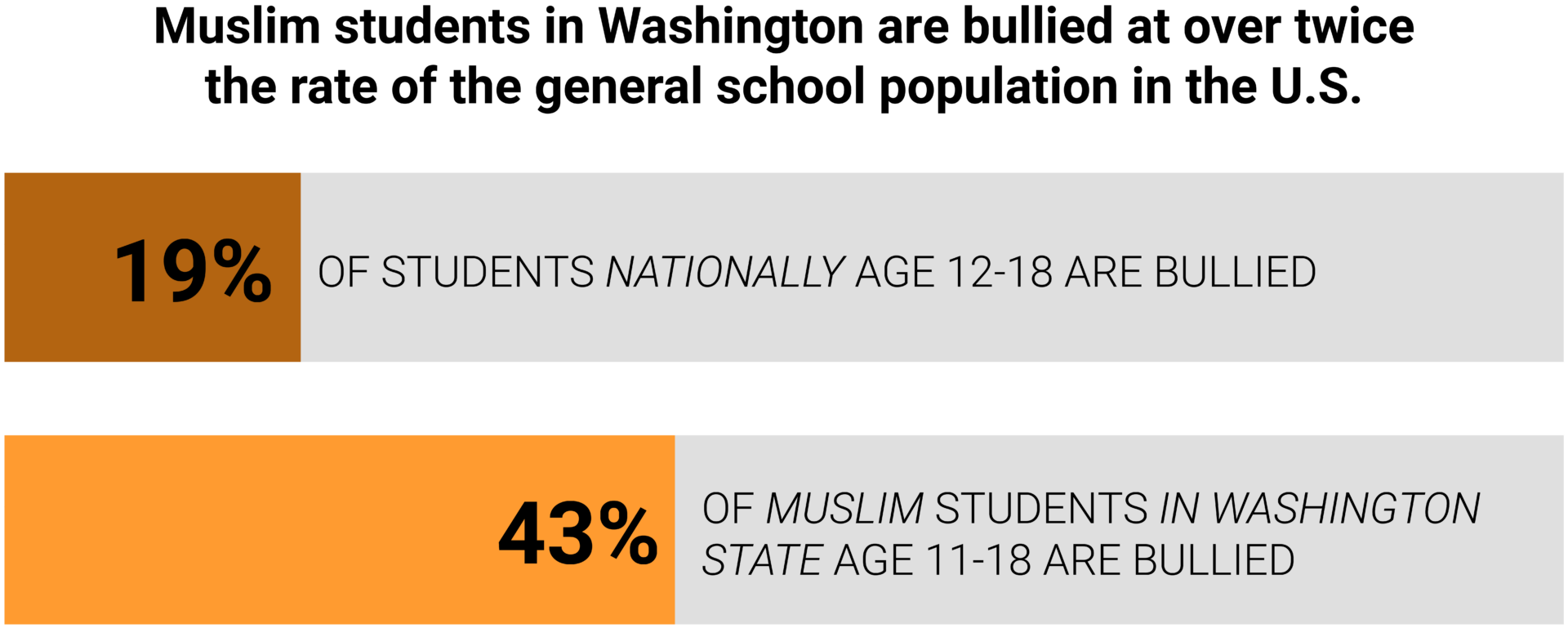
According to stopbullying.gov, the national average is 19%, while for Muslim students in Washington the rate of students who were bullied in the past school year is 43%. Additionally, over one-third (37%) of Muslim students in Washington have seen adults in their school make comments or act in a way that is offensive to Islam or Muslims in the past 2 school years, and one-third (33%) have experienced discriminatory policies or practices.
Respondents noted hearing pervasive language from both other students and from teachers linking Islam to violence and spreading misinformation about Islam and Muslims.
Our sample size was small, and so correlations with a statistical significance were few. However, two clear correlations were as follows. Muslim girls in Washington are more likely to experience discriminatory policies, and Muslim students who are “African” or “Black/African-American and African” were more likely to be discouraged from pursuing their education and to feel that their teachers do not understand Islam or Muslims.
Links to download and print materials
Resources and Further Reading
If you are interested in further resources regarding Islamophobia and bullying in schools, please refer to the list of resources below.
CAIR-WA’s incident report form: cairwa.org/gethelp. Fill out if you or someone you know has experienced bias, hate, or discrimination because they are Muslim (or perceived as Muslim), or to reach our Immigrant Justice Project.
CAIR-WA’s Know Your Rights Website at knowyourrightswa.com
The Seattle Office of Civil Rights at seattle.gov/civil-rights
CAIR National Civil Rights Reports at cair.com
An Educator’s Guide to Islamic Religious Practices by CAIR National at cairwa.org/resources
CAIR’s Guide to Addressing Bullying and Bias in Schools by CAIR National at islamophobia.org/anti-prejudice-tools/cairs-guide-to-bullying-and-bias-in-schools/
CAIR’S 2025-2026 Back to School Resource Guide at islamophobia.org/anti-prejudice-tools/unhostile-campus-back-to-school-guide/
The Othering & Belonging Institute’s section on Islamophobia at belonging.berkeley.edu/islamophobia
CAIR California’s 2023 Bullying Report at ca.cair.com/publications/2023-bullying-report/
StopBullying.gov
The Institute for Social Policy and Understanding’s page on Youth at ispu.org/social-policy/youth/
If you have any questions, comments, or find any errors in this report, please contact Katie Walker, CAIR-WA Communications Director, at kwalker@cair.com.